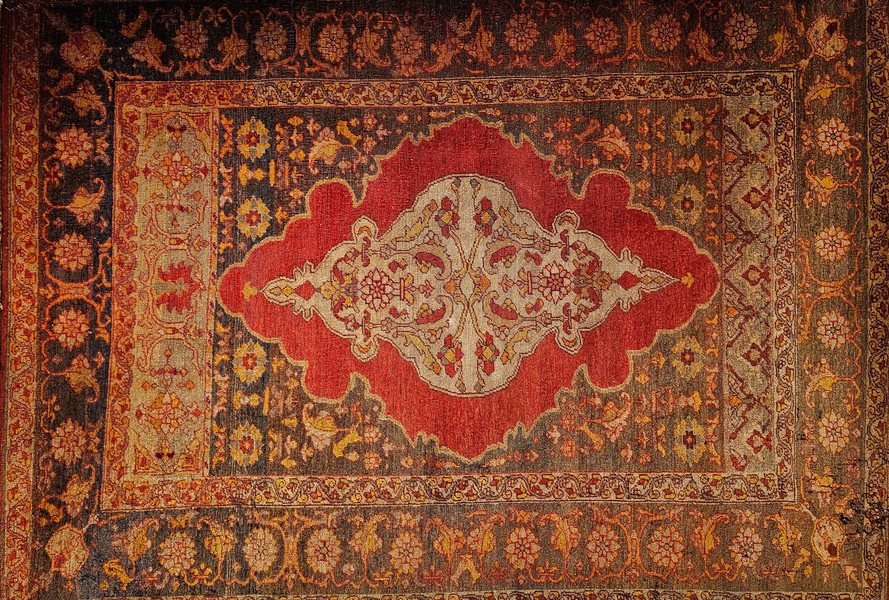
An exquisite and exceptionally rare 19th century Tehran rug, handwoven in one of the most renowned workshops of the Persian capital during the late 1800s — a period when the Qajar court of Tehran was commissioning the finest carpets in Persia. This masterpiece features a central vase motif overflowing with life and abundance, its graceful tree branches reaching heavenward adorned with delicate depictions of birds and fawns throughout a luminous cream field of extraordinary purity. The combination of wool and silk pile gives the composition a shimmering depth that shifts beautifully with changing light.
Tehran rugs of the Qajar era are celebrated among connoisseurs for their refined elegance, intricate artistry, and extremely limited production — fewer Tehran rugs were made in the 19th century than in any other major Persian weaving city, and each surviving example carries exceptional collecting significance. Tehran rugs, woven in the workshops of the Persian capital, represent some of the rarest and most refined carpets produced in Persia during the 19th and early 20th centuries. Unlike the great weaving centers of Tabriz, Isfahan, and Kashan — which produced rugs in considerable volume — the Tehran workshops operated on a small, exclusive scale, producing carpets for the court of the Qajar Dynasty and the grand households of the Persian aristocracy. Tehran rugs are distinguished by their extraordinarily fine weave, the exceptional quality of their wool and silk, and a design vocabulary of great classical refinement. Genuine 19th century Tehran rugs are extremely rare on the market and are actively sought by the most serious collectors of antique Persian carpets.
Dimensions: 4' 4" x 7' 2"
Date of Manufacture: 4th Quarter of the 1800s
Place of Origin: Persia (Tehran)
Material: Wool and silk pile on a cotton foundation