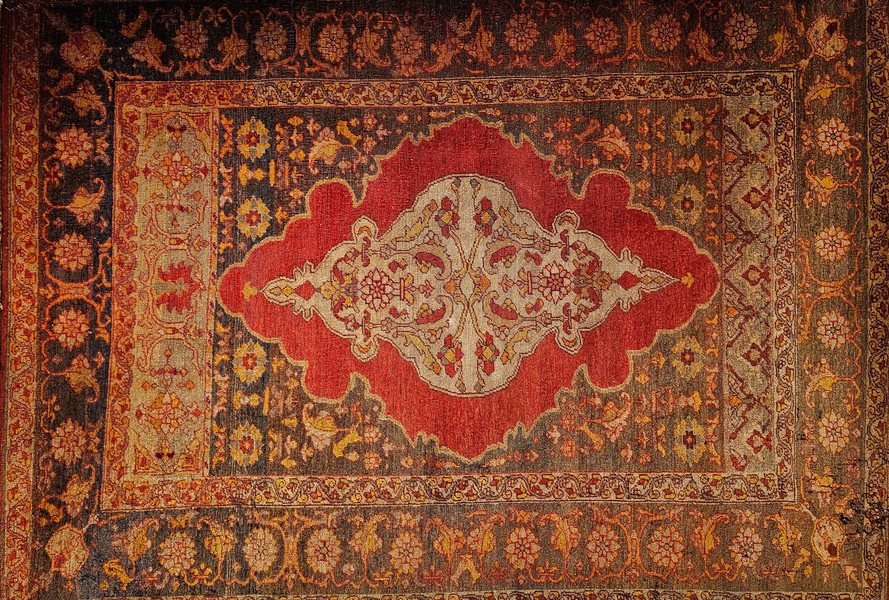
This 19th century Turkish Oushak from the fourth quarter of the 1800s is a piece of the late Victorian era of Anatolian weaving — a period when the great workshops of Oushak were producing carpets that found their way into the grandest homes and palaces of Europe and America. The design and color combination perfectly reflect the aesthetic of the Art Nouveau period in which this carpet was woven — the variation in the green and light blue palette adding distinction and depth to a composition of natural elegance.
The subtle tonal shifts in the green and blue, natural results of hand-dyeing wool with vegetable pigments, give this piece a painterly quality that no uniformly dyed textile can replicate. Oushak rugs, woven in the city of Uşak in western Turkey, occupy a singular position in the world of antique carpets. Distinguished by their large-scale geometric medallions, their luminous palette of soft golds, ivory, and terracotta, and the extraordinary quality of their long-staple Anatolian wool, Oushak rugs have been prized by European collectors since the Renaissance — appearing in the paintings of Holbein, Lotto, and Memling as symbols of wealth and refinement. Today, authentic antique Oushak rugs are among the most sought-after pieces in the interior design world, prized for their ability to bring warmth, elegance, and a timeless quality to both traditional and contemporary spaces.
Dimensions: 4' 4" x 5' 10"
Date of Manufacture: 4th Quarter of the 1800s
Place of Origin: Turkey (Oushak)
Material: Wool on a cotton foundation with vegetable dyes