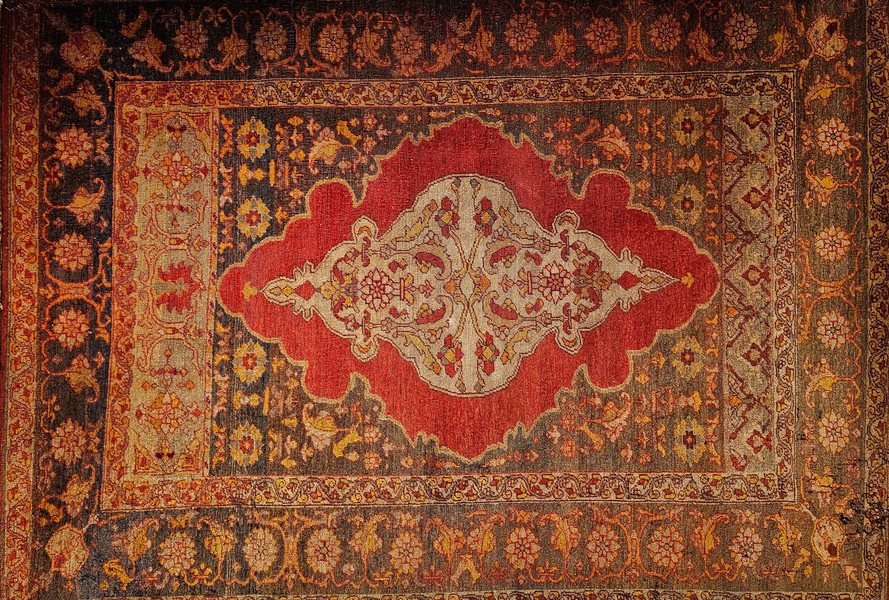
This breathtaking early 20th century Tabriz Mahi rug exemplifies the mastery of one of Tabriz's finest city workshops — a piece of exceptional scale, precision, and enduring beauty. Woven with an extraordinarily high knot count, it showcases the renowned Mahi (fish) motif in a composition of remarkable clarity and rhythmic harmony, the interlocking rosettes and lanceolate leaves of the Herati field rendered with the meticulous precision that distinguishes the best Tabriz workshop production.
The rug's richly articulated border enhances the composition with elegant detail, creating a frame that is both visually striking and stylistically timeless. At over 13 by 19 feet, this is a gallery and ballroom scale piece of the highest order — one of those rare acquisitions that defines a room rather than merely furnishing it. Silk highlights add shimmering depth to selected design elements. Tabriz, the ancient capital of Persian Azerbaijan and one of the great trading cities of the Silk Road, has been a center of carpet weaving for centuries. The city's workshops produce rugs of extraordinary technical precision and design sophistication — ranging from the classical floral medallion compositions of the great 19th century masters to the bold geometric and Mahi patterns for which Tabriz is equally celebrated. Tabriz rugs are among the most recognized and sought-after Persian carpets in the world.
Dimensions: 13' 3" x 19' 4"
Date of Manufacture: 2nd Quarter of the 20th Century
Place of Origin: Persia (Tabriz)
Material: Wool pile on a cotton foundation with silk highlights