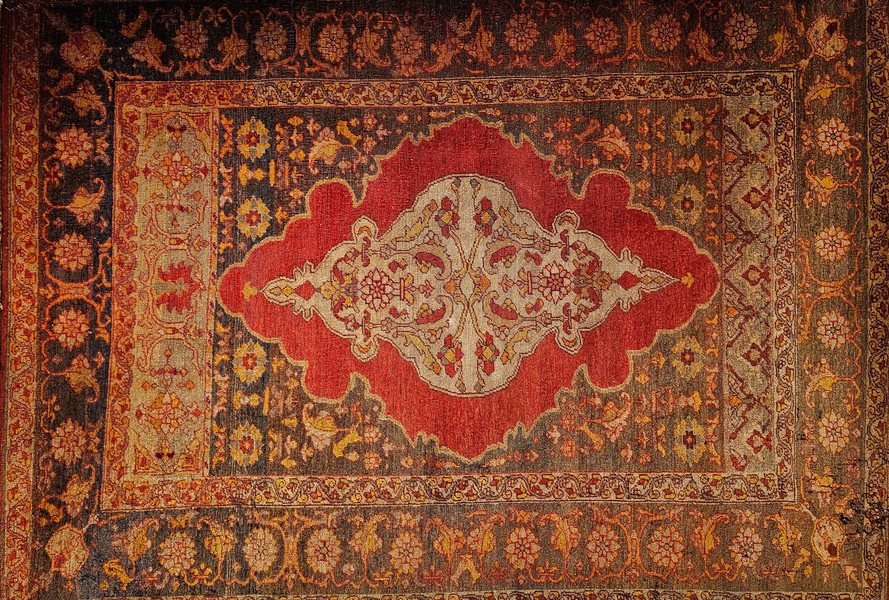
This one-of-a-kind Persian Tehran carpet carries extraordinary provenance: its Arts and Crafts design was taken from an original carpet in the collection of Princess Ashraf Molouk Fakhrodoleh of the Qajar Dynasty of 19th century Persia, created as a personal gift to the Princess and therefore known as the 'Princess Fakhrodoleh' carpet. The design's beautiful simplicity — with its clean botanical forms and restrained palette — resonates deeply with the Arts and Crafts movement of the late 19th century West, and with the Prairie School design philosophy of Frank Lloyd Wright in the early to mid-20th century.
That a Persian court carpet should find such natural kinship with the most progressive Western design movements of its era is a testament to the universal language of honest craftsmanship and natural beauty that both traditions share. Woven on a silk foundation with natural vegetable dyes, this piece is in new and excellent condition — a museum-quality textile of exceptional historical and artistic significance. Tehran rugs, woven in the workshops of the Persian capital, represent some of the rarest and most refined carpets produced in Persia during the 19th and early 20th centuries. Unlike the great weaving centers of Tabriz, Isfahan, and Kashan — which produced rugs in considerable volume — the Tehran workshops operated on a small, exclusive scale, producing carpets for the court of the Qajar Dynasty and the grand households of the Persian aristocracy. Tehran rugs are distinguished by their extraordinarily fine weave, the exceptional quality of their wool and silk, and a design vocabulary of great classical refinement. Genuine 19th century Tehran rugs are extremely rare on the market and are actively sought by the most serious collectors of antique Persian carpets.
Dimensions: 6' 6" x 10'
Date of Manufacture: 4th Quarter of the 20th Century
Place of Origin: Persia (Tehran)
Material: Wool pile on a silk foundation with vegetable dyes