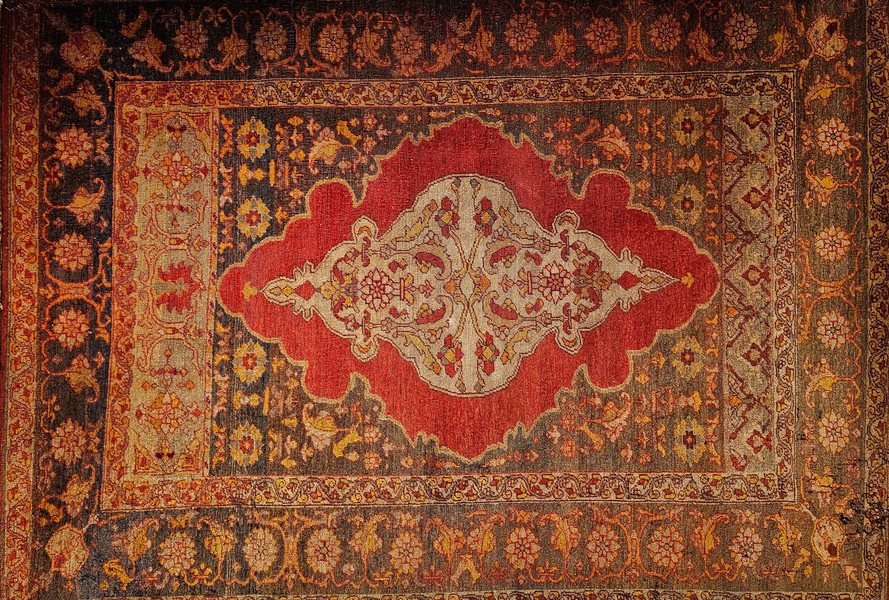
This exceptional handwoven Anatolian prayer rug from the fourth quarter of the 19th century showcases the artistry of late 19th century Turkish village weaving at its most bold and expressive, enhanced by natural vegetable dyes that have mellowed beautifully over more than a century of age. The rug features a striking geometric directional design set within a rich red field — a composition that draws on the visual vocabulary of both Anatolian and Caucasian tribal weaving traditions.
A terracotta border and elegant turquoise upper spandrel provide a color contrast of unusual beauty, while ivory, green, and blue accents add balance and harmony throughout. Adding to its provenance and desirability, this Anatolian village rug comes from the private collection of a renowned San Francisco vintage rug connoisseur — a pedigree that speaks to its quality, authenticity, and collecting significance. The Anatolian prayer rug tradition is one of the most ancient and spiritually resonant in the entire textile world. The mihrab — the arched niche that orients the rug toward Mecca — gives these rugs their distinctive directional quality and their connection to the devotional life of Islam. Village prayer rugs of the 19th and early 20th century are among the most personal and expressive textiles ever made, each a unique expression of the individual weaver's artistic sensibility within a form of deep religious significance.
Dimensions: 3' 3" x 5'
Date of Manufacture: 4th Quarter of the 19th Century
Place of Origin: Anatolia (Turkey)
Material: Wool pile on a wool foundation with vegetable dyes