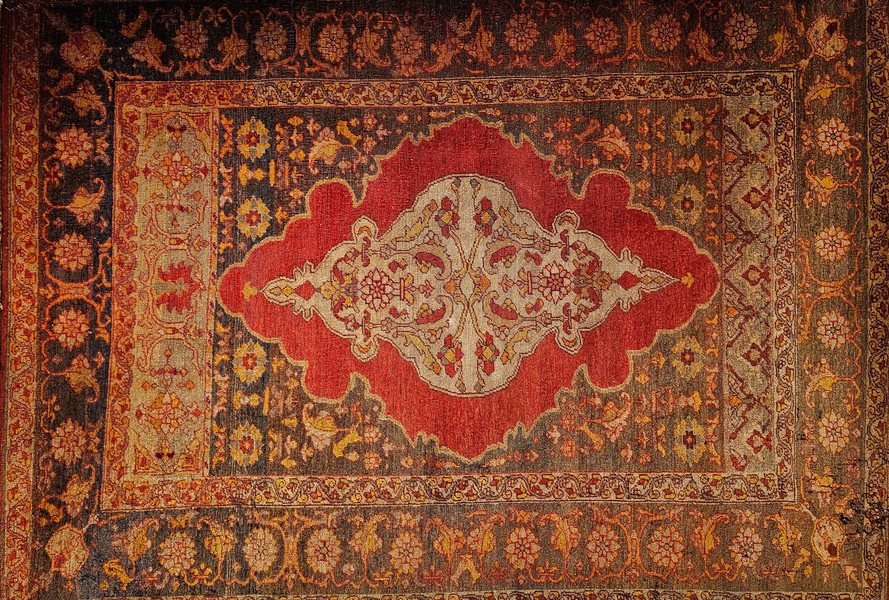
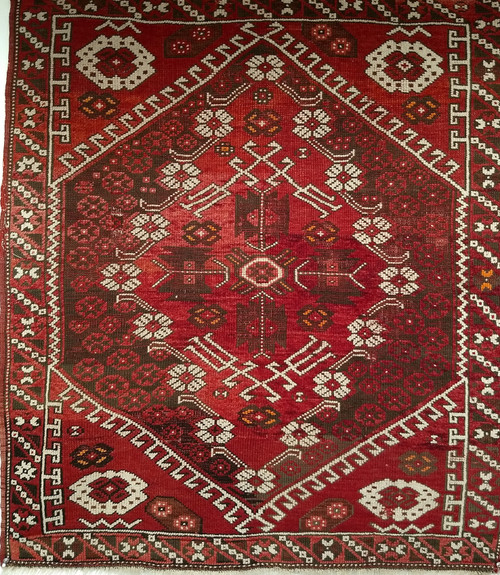
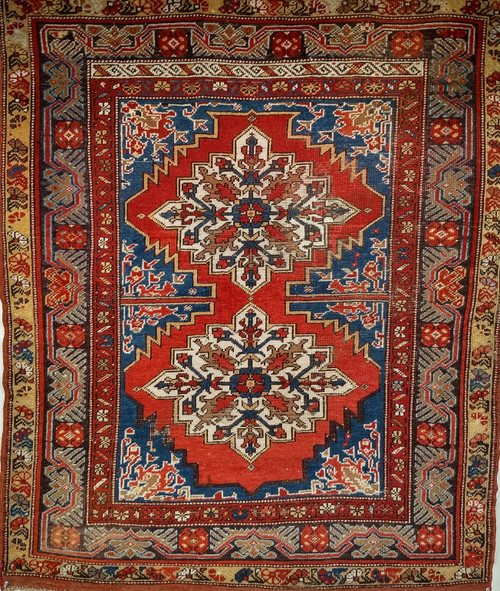
This near-square antique Turkish village rug is a striking example of Anatolian craftsmanship, showcasing a bold geometric pattern that reveals the deep cultural crossroads of Eastern Anatolia — where the weaving traditions of Turkey, the Caucasus, and Persia converge and enrich one another. The geometric composition, reminiscent of Caucasian prayer rugs, is rendered in a harmonious palette of terracotta, ivory, turquoise blue, forest green, and rich red, all achieved through natural vegetable pigments.
The central medallion design and balanced proportions give this small rug a visual authority far beyond its scale — equally compelling as a floor accent, a table covering, or a wall-hung textile. The near-square format is itself a rarity in Anatolian village weaving, adding to the piece's collecting interest. The Anatolian prayer rug tradition is one of the most ancient and spiritually resonant in the entire textile world. The mihrab — the arched niche that orients the rug toward Mecca — gives these rugs their distinctive directional quality and their connection to the devotional life of Islam. Village prayer rugs of the 19th and early 20th century are among the most personal and expressive textiles ever made, each a unique expression of the individual weaver's artistic sensibility within a form of deep religious significance.
Dimensions: 2' 9" x 3'
Date of Manufacture: 4th Quarter of the 19th Century