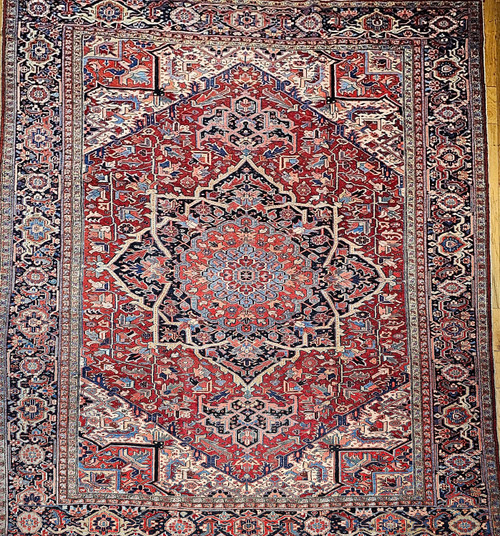
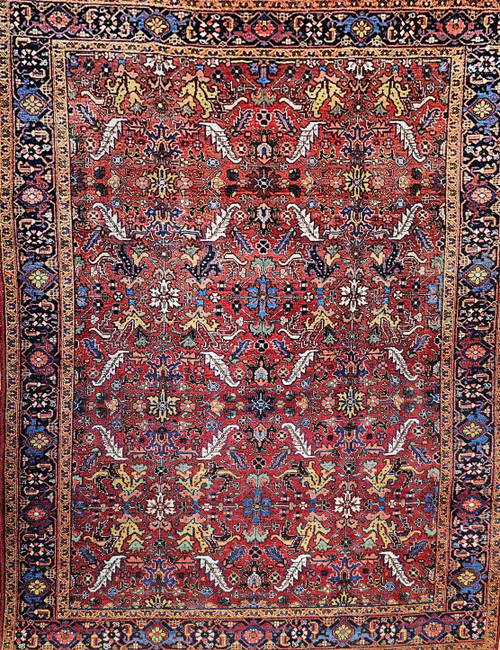
This rare and desirable early 20th century Persian Heriz rug, dating from the first quarter of the 1900s, is uniquely woven in a smaller room-size format — a highly sought-after scale for more intimate interiors. The rug showcases an open field design with an ivory corner spandrel motif surrounding a striking red field. A refined central medallion in French blue and ivory lends distinguished elegance, highly prized by collectors. The navy border provides bold contrast, and the full, thick pile demonstrates both the quality of construction and the exceptional durability of the Heriz tradition.
Heriz rugs, woven in the village of Heriz and surrounding towns of the Azerbaijan region in Northwest Persia, are among the most recognized and beloved antique Persian carpets in the world. Distinguished by their bold geometric medallions, their warm brick-red and ivory palettes, and the exceptional durability of their double-wefted construction, Heriz rugs have furnished the grand rooms of Europe and America since the late 19th century. The finest early examples — particularly those designated Serapi, woven in the 19th century villages north of Heriz — are among the most actively collected antique rugs in the world today.
Dimensions: 6' 7" x 8' 11"
Date of Manufacture: 1st Quarter of the 1900s
Place of Origin: Northwest Persia (Heriz region)
Material: Wool pile on a cotton foundation with vegetable dyes