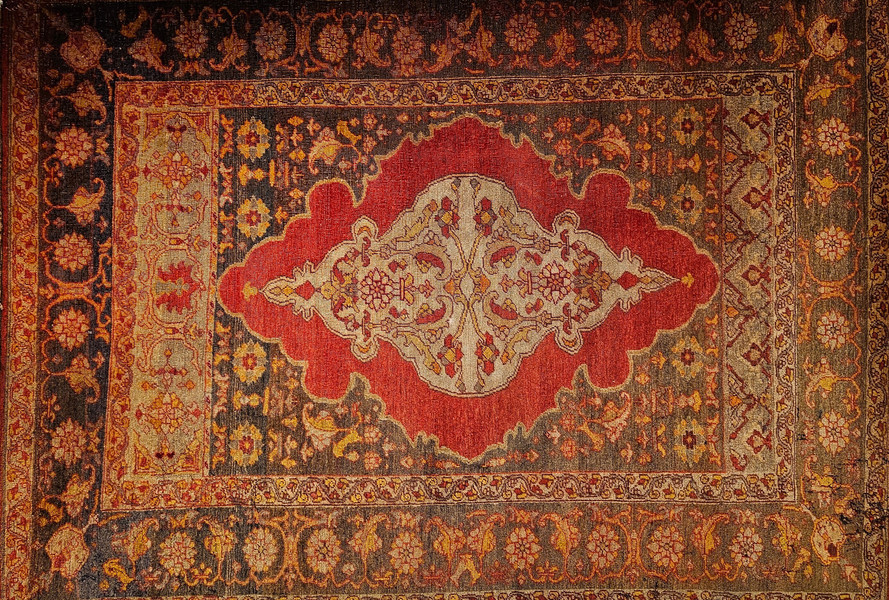
An exceptional 19th century Caucasian Kazak area rug, handwoven in the late 1800s, showcasing five striking Memling Gul medallions arranged in a column — one of the most ancient and symbolically resonant design formats in the entire Kazak weaving tradition. The medallions, rendered in brick red and pale yellow, rest on a rare abrash French blue field of extraordinary depth and tonal complexity, achieved through natural vegetable dyes that have aged beautifully over more than a century.
The Memling Gul — named for the Flemish Renaissance painter Hans Memling, whose works depict similar forms in Oriental carpets — is among the oldest continuous design motifs in the Central Asian and Caucasian rug tradition, and its appearance in a Kazak rug of this quality and age carries particular resonance for the serious collector. The ivory border with its geometric motifs in terracotta, blue, green, and soft yellow provides a refined counterpoint to the bold field design. Kazak rugs, woven by village artisans in the mountainous region of the South Caucasus — encompassing present-day Armenia, Azerbaijan, and Georgia — are among the most boldly designed and vibrantly colored tribal rugs in the world. Their large-format geometric medallions, brilliant vegetable-dyed palette, and the thick, lustrous pile made from high-altitude mountain wool have made them enduringly sought after by collectors and interior designers who prize authenticity, energy, and the beauty of genuine handcraft.
- Dimensions: 3' 8" x 7' 3"
- Date of Manufacture: 4th Quarter of the 1800s
- Place of Origin: Caucasus
- Material: Wool pile on a wool foundation with vegetable dyes
- Condition: Wear consistent with age and use
SKU: 1883