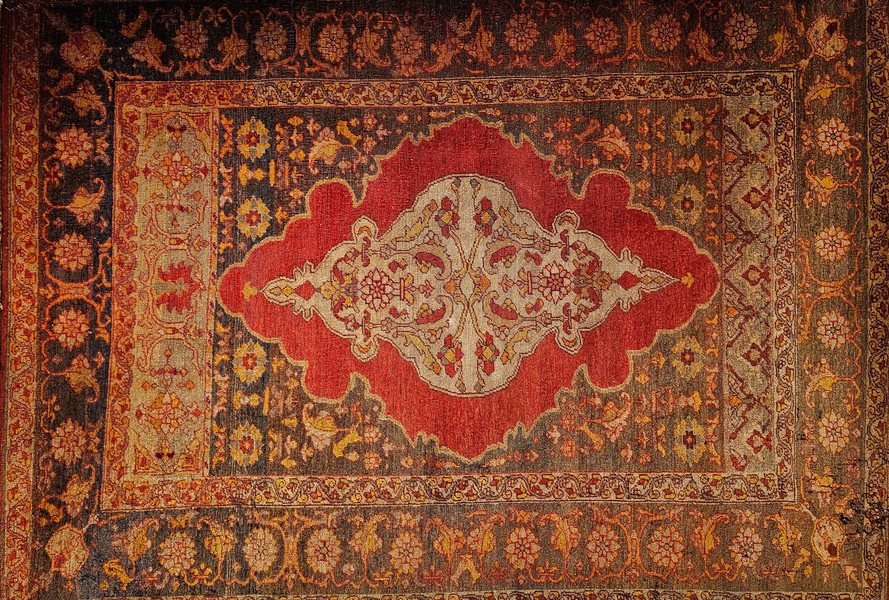
A rare and visually captivating vintage Persian Malayer runner from the third quarter of the 20th century, featuring an unusual and beautiful robin's egg blue field — one of the most uncommon and sought-after colors in Persian village weaving. The central design showcases six connected axial medallions, each bearing intricate floral motifs in navy, ivory, and blue, all set within warm red cartouches that create a rhythmic and balanced composition of considerable visual energy.
The ivory border adorned with stylized geometric and floral elements in red, green, and blue provides a refined contrast to the luminous blue field. This is a superb example of Malayer craftsmanship at its most inventive — a piece that demonstrates the remarkable color range and design creativity available to village weavers working within a well-established but never formulaic tradition. The Malayer district of Western Persia — located in the Hamadan province, east of the Zagros Mountains — produced village rugs of remarkable quality and diversity throughout the 19th and early 20th centuries. Malayer rugs are distinguished by their fine weave, their inventive use of design formats drawn from both the Hamadan and Sarouk traditions, and a palette of naturally dyed wool whose depth and complexity reward close study. The finest Malayer rugs, particularly those in the camel hair field and Herati allover formats, are among the most sought-after village rugs of Western Persia.