Timeless Beauty. Sustainable Living.

Handwoven a century ago.   Built to last another hundred years.

Malayer 1176

$6,900.00
Adding to cart… The item has been added

Description

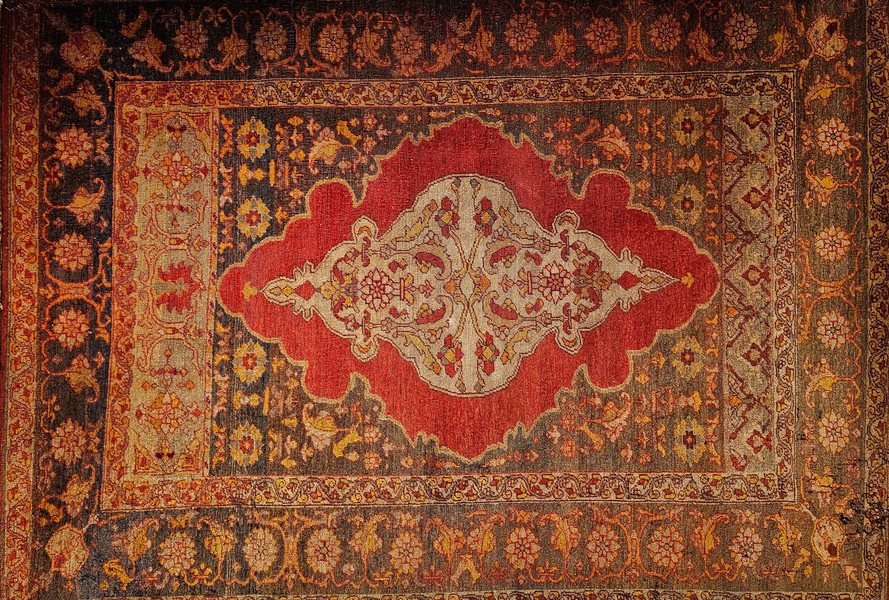
This late 19th century Persian Malayer rug from the fourth quarter of the 1800s features a sophisticated allover Herati pattern — a classic geometric motif prized for its balance, rhythm, and timeless visual appeal — set against a deep navy-blue field of great richness and depth. The intricate design is enriched with subtle accents of brown and French blue, creating a composition of visual movement and tonal complexity.

The ivory and tan border, adorned with elegant Gol Farang — 'foreign flower' — motifs reminiscent of the celebrated Bidjar weaving tradition, frames the composition with a decorative refinement that elevates this piece above standard village production. Gol Farang motifs, derived from European floral prints that entered the Persian design vocabulary in the 19th century, add an unusual cosmopolitan note to what is otherwise a deeply traditional composition. The Malayer district of Western Persia — located in the Hamadan province, east of the Zagros Mountains — produced village rugs of remarkable quality and diversity throughout the 19th and early 20th centuries. Malayer rugs are distinguished by their fine weave, their inventive use of design formats drawn from both the Hamadan and Sarouk traditions, and a palette of naturally dyed wool whose depth and complexity reward close study. The finest Malayer rugs, particularly those in the camel hair field and Herati allover formats, are among the most sought-after village rugs of Western Persia.

Dimensions: 4' x 6' 4"
Date of Manufacture: 4th Quarter of the 1800s
Place of Origin: Persia (Malayer district)
Material: Wool pile on a wool foundation with vegetable dyes
Condition: Wear consistent with age and use

SKU: 1176

Videos Hide Videos Show Videos

Related Products

Compare