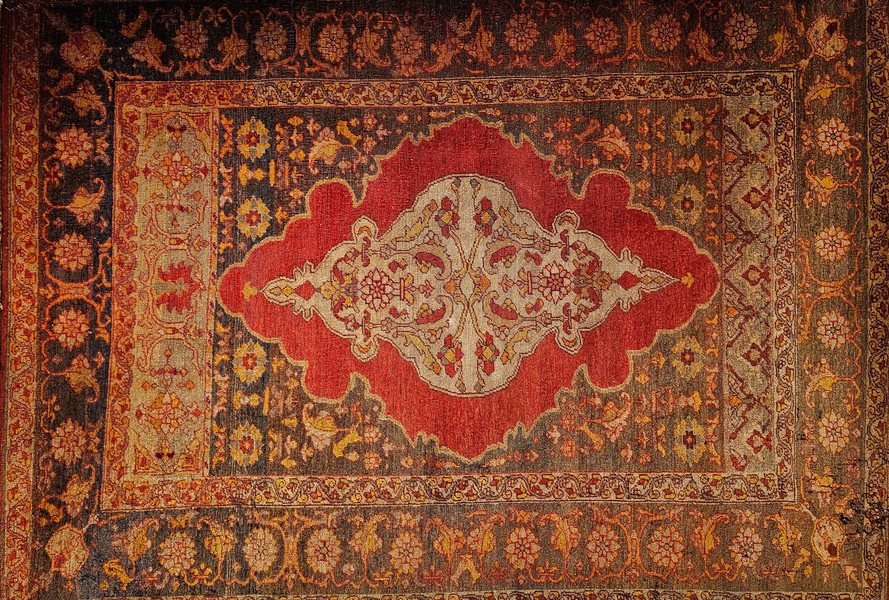
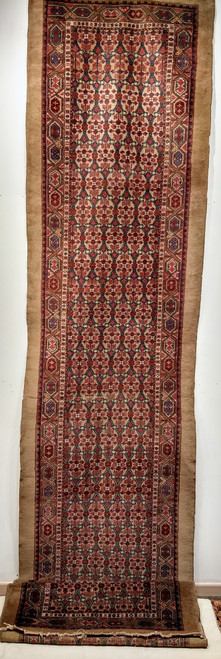
This late 19th century Persian Serab camelhair runner carries the unmistakable character of the Serab village weaving tradition in its most elemental form — a long, narrow runner woven in the traditional tribal geometric vocabulary of the Northwest Persian mountains, the undyed camel hair field providing the warm, organic foundation that makes Serab runners among the most naturally beautiful textiles in the antique rug world. Though worn in some areas as befits a piece over 125 years old, it retains the visual power and authentic character that only genuine antique textiles of this vintage carry.
Note that Serab camelhair runners 1302 and 1303 have similar design and color palettes and can be joined together to create a much longer runner — an extraordinary option for a grand hallway or gallery corridor. Serab rugs, woven in the village of Serab and surrounding areas in the mountains of Northwest Persia south of Tabriz, are among the most coveted antique rugs by serious collectors and interior designers worldwide. Distinguished above all by their use of naturally colored camel hair — which gives the field a warm, honey-toned luminosity impossible to replicate with dyed wool — Serab rugs are celebrated for their extraordinary fineness of weave, their restrained geometric designs, and a palette of natural undyed camel and vegetable-dyed accents that achieves a beauty of uncommon depth and understatement. The runner format is the most traditional Serab proportion, and 19th century examples in good condition are among the most actively traded pieces in the antique rug market.
Dimensions: 3' 10" x 14'
Date of Manufacture: 4th Quarter of the 1800s
Place of Origin: NW Persia (Serab region)
Material: Wool pile on a wool foundation with natural vegetable dyes and camel hair