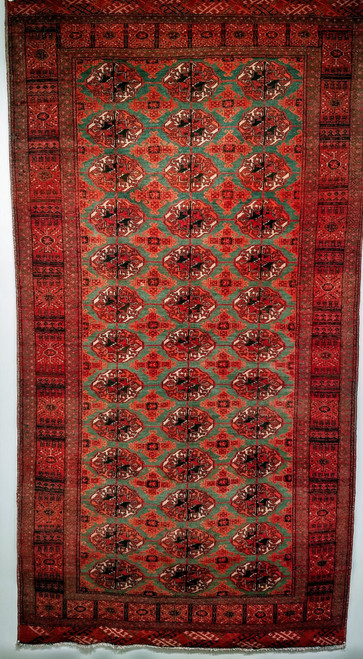
This authentic vintage Turkmen area rug from Central Asia, handwoven with precision in the second quarter of the 20th century, features the classic three-column arrangement of repeating geometric gul medallions — the octagonal forms that are the defining symbol of Turkmen weaving, each gul representing the heritage, identity, and tribal affiliation of the weaving clan. The deep red field is complemented by multiple geometric borders alternating between ivory and red tones that frame the composition with rhythmic precision.
The gul — meaning 'flower' in Turkmen — is far more than a decorative element: it is a tribal emblem, a mark of identity that was specific to each tribe and sub-tribe, and its confident repetition across this rug's field creates a surface of meditative depth and cultural richness. Turkmen rugs, woven by the nomadic and semi-nomadic tribal peoples of Central Asia — principally the Tekke, Yomut, Ersari, Saryk, and Salor — are among the most instantly recognizable and actively collected tribal textiles in the world. Distinguished by their deep, saturated crimson fields, their repeating octagonal gul medallions, their exceptionally fine high-density pile, and the extraordinary quality of their hand-spun and vegetable-dyed wool, Turkmen rugs combine geometric precision with a richness of material quality that has made them prized from the bazaars of Bukhara to the auction rooms of New York and London.
Dimensions: 3' 5" x 5' 8"
Date of Manufacture: 2nd Quarter of the 1900s
Place of Origin: Central Asia (Turkmen tribal region)