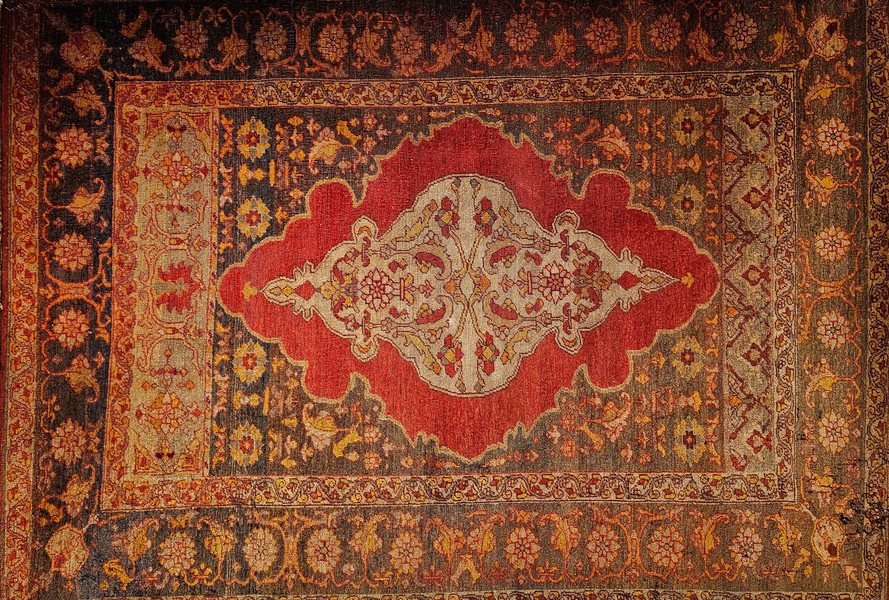
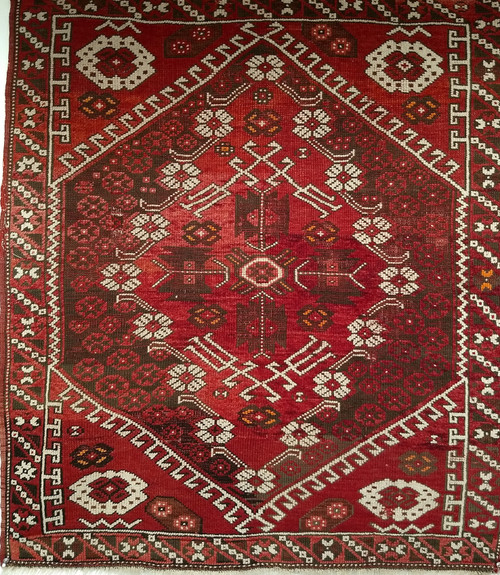
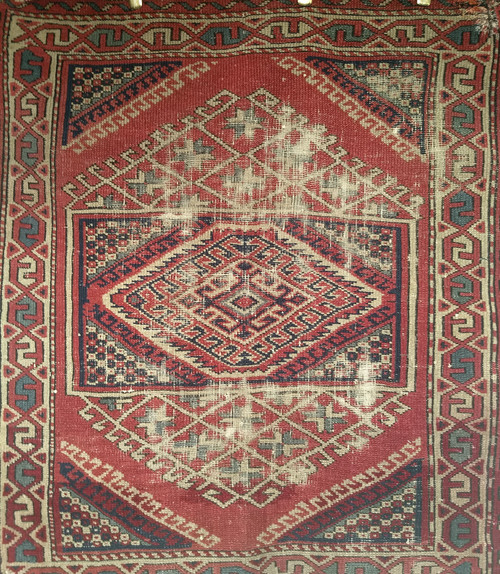
This exceptional 19th Century Turkish Anatolian village rug is a rare and visually powerful example of late Ottoman-era tribal weaving, distinguished by its dramatic geometry and rich, naturally dyed palette. Woven in the Anatolia region of Turkey in the late 1800s, the rug is composed in the traditional prayer-format, lending both symbolic meaning and architectural balance to the design.
What makes this piece especially desirable is its strong visual connection to the celebrated Kazak “Eagle” pattern of the Caucasus—a motif associated with protection, strength, and spiritual guardianship. Two bold Eagle medallions dominate the field, floating majestically against a luminous abrash French blue ground, whose subtle tonal shifts reveal the use of hand-dyed, natural pigments.
The composition is framed by an elegant triple-border system in saturated red, deep navy, and warm yellow, creating both contrast and visual structure. This carefully layered border treatment enhances the rug’s graphic presence while maintaining the refined balance characteristic of the finest village weavings. Handwoven from hand-spun wool and natural vegetable dyes.
Adding to its distinction, this rug originates from the private collection of a renowned San Francisco vintage rug connoisseur.
- Dimensions: 3' 9" x 4' 7"
- Date of Manufacture: 4th Quarter 19th Century
- Place of Origin: Anatolia
- Material: Wool pile on a wool foundation with vegetable dyes
- Condition: Wear consistent with age and use
SKU: 1593